
Views: 44 Author: Elena Publish Time: 2026-04-15 Origin: www.fuchun-casting.com


Precision casting, also known as investment casting, is widely used in demanding industries such as jet engines, gas turbines, steam turbines, aircraft parts, internal combustion engines, vehicles, food machinery, printing machinery, paper machinery, compressors, valves, pumps, meters, sewing machines, weapons, business machines, and many other mechanical components. Achieving high dimensional accuracy in manufacturing process is critical for these applications, as even small deviations can lead to assembly problems, performance loss, or premature failure.
Generally speaking, the dimensional accuracy of precision castings is influenced by many factors, including casting structure, casting material, mould making, shell making, roasting, pouring, and post-processing. Any unreasonable step or improper operation will change the shrinkage rate of the casting, resulting in deviations from the required dimensions. While casting materials (such as alloy composition) play a significant role, there are several other key factors that affect dimensional accuracy. This article focuses on the question: Besides casting materials, what causes the casting dimensional accuracy?
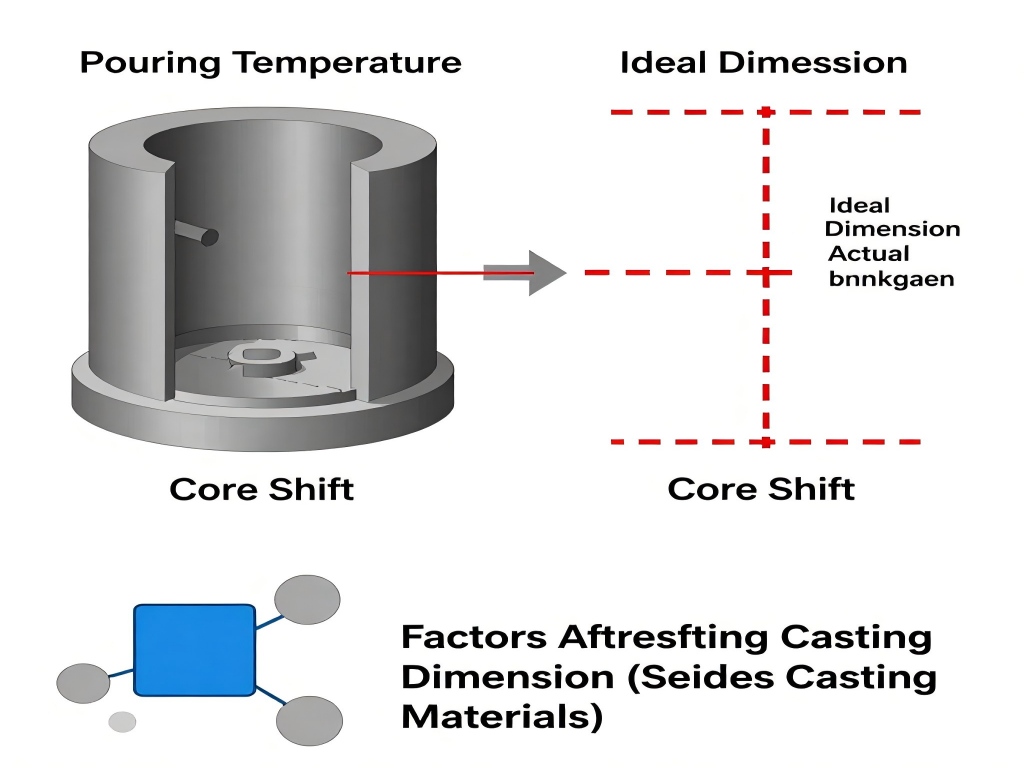
The pouring temperature directly affects the solidification behavior of molten metal. The higher the pouring temperature, the greater the superheat, and consequently the larger the shrinkage during cooling. Conversely, a lower pouring temperature reduces shrinkage. However, if the temperature is too low, it may cause misrun or cold shut defects. Therefore, controlling pouring temperature within an optimal range is essential to maintain consistent dimensional accuracy. This is a typical example of how casting process and defects are interconnected: improper temperature leads to shrinkage cavities, porosity, or dimensional drift.
The wall thickness of a casting significantly influences shrinkage rate. In general, the larger the wall thickness, the greater the shrinkage, because thicker sections retain more heat and take longer to solidify. Moreover, in precision casting, the wax pattern thickness increases with wall thickness, and the wax itself has a certain shrinkage coefficient. The interaction between wax shrinkage and metal shrinkage can cause dimensional errors. Thick-walled sections also hinder free contraction due to the mechanical restriction from the surrounding mold, leading to internal stresses and distortion.
The ceramic shell used in investment casting is typically made from zirconium sand, zirconium powder, or other refractory materials. Zirconium-based materials have excellent thermal stability and are little affected by temperature changes, which helps maintain shell integrity. However, the shell thickness plays a critical role: a thicker shell mechanically restrains the solidifying casting, reducing its shrinkage. A thinner shell allows more shrinkage but may lack strength to withstand the metal pressure. Therefore, shell thickness must be carefully designed and uniformly applied. The choice of casting material for molds (i.e., the shell material) directly influences the final dimensional accuracy because different refractories have different coefficients of thermal expansion and mechanical strength.
The dimensional change caused by shell roasting itself is usually negligible because the ceramic shell is pre-sintered. However, several related issues can severely degrade accuracy:
Shell deformation during roasting – uneven heating or improper support can warp the shell.
Shell swelling caused by dewaxing – when wax is removed by steam or flash fire, the rapid expansion of wax can crack or enlarge the shell cavity.
Floating core – during pouring, the ceramic core may shift due to buoyancy or metal flow, leading to wall thickness variation and positional errors.
These problems can reduce the size tolerance grade of castings by one or two levels. Regular dimensional accuracy measurement using coordinate measuring machines (CMM), optical scanners, or precision gauges is necessary to detect such deviations early in production.
5. Carbon Content and Alloying Elements
Among material-related factors (the subject we are “besides”), it is worth noting that even within the same alloy family, carbon content significantly affects linear shrinkage. Higher carbon content reduces linear shrinkage, while lower carbon content increases shrinkage. Furthermore, different alloying elements (such as silicon, manganese, chromium, nickel, molybdenum) each have unique effects on solidification contraction and phase transformation. Therefore, precise control of alloy chemistry is essential for achieving consistent dimensions.
6. Mould (Wax Pattern) Quality
Although not explicitly listed in the original five factors, the quality of the wax pattern – which is essentially the casting material for molds in the context of expendable patterns – directly impacts dimensional accuracy. Wax injection temperature, pressure, holding time, and pattern storage conditions all cause pattern shrinkage or warpage. Any deviation in the pattern will be replicated in the final casting.
To ensure high dimensional accuracy, manufacturers employ various dimensional accuracy measurement techniques. These include:
Contact methods: calipers, micrometers, and CMM probes.
Non-contact methods: laser scanning, structured light 3D scanning, and optical comparators.
In-line statistical process control (SPC) to monitor shrinkage trends.
By integrating measurement feedback into the casting process and defects analysis, foundries can adjust parameters such as pouring temperature, shell thickness, and dewaxing procedures to compensate for predictable shrinkages.
In summary, besides casting materials, the dimensional accuracy of precision castings is affected by pouring temperature, wall thickness, shell thickness and material, roasting/dewaxing conditions, core stability, and wax pattern quality. Understanding these factors and implementing rigorous dimensional accuracy measurement protocols are essential for producing high-quality castings for critical applications. The broad casting process applications – from aerospace to food machinery – demand reliable accuracy, and only by controlling all the above variables can manufacturers meet stringent specifications.


