
Views: 76 Author: Elena Publish Time: 2026-05-09 Origin: www.fuchun-casting.com


Hydraulic cylinders are mechanical actuators that convert hydraulic energy (pressurized fluid) into linear motion and force. They are essential components in countless industrial and mobile applications, providing the power needed to lift, push, pull, or hold heavy loads with precision and reliability. From construction sites to factory floors, hydraulic cylinders enable machines to perform tasks that would otherwise be impossible.
The Role of Hydraulic Cylinders in Modern Industry
Hydraulic cylinders play a large role in most industries. They are used in many daily mechanical devices, including construction equipment (such as excavators, bulldozers, and backhoes), manufacturing machinery (presses, injection molding machines), and civil engineering projects (bridge lifting systems, dam gates). Without hydraulic cylinders, modern infrastructure and mass production would grind to a halt.
How Do Hydraulic Cylinders Work?
The hydraulic pressure in these cylinders is generated by hydraulic fluids (typically oils) that are stored under pressure. The energy stored in these fluids is converted into controlled linear motion. In a complete hydraulic system, a hydraulic actuator consists of one or more hydraulic cylinders. A pump regulates the oil flow within the system, drawing fluid from a reservoir and pushing it through valves and hoses to the cylinder. The pump is part of the power source of a hydraulic system. The hydraulic cylinders respond to the pressure of the oil, but the actual pressure developed is determined by the load resistance—it never exceeds what is required to move the load.
Key Components of a Hydraulic Cylinder
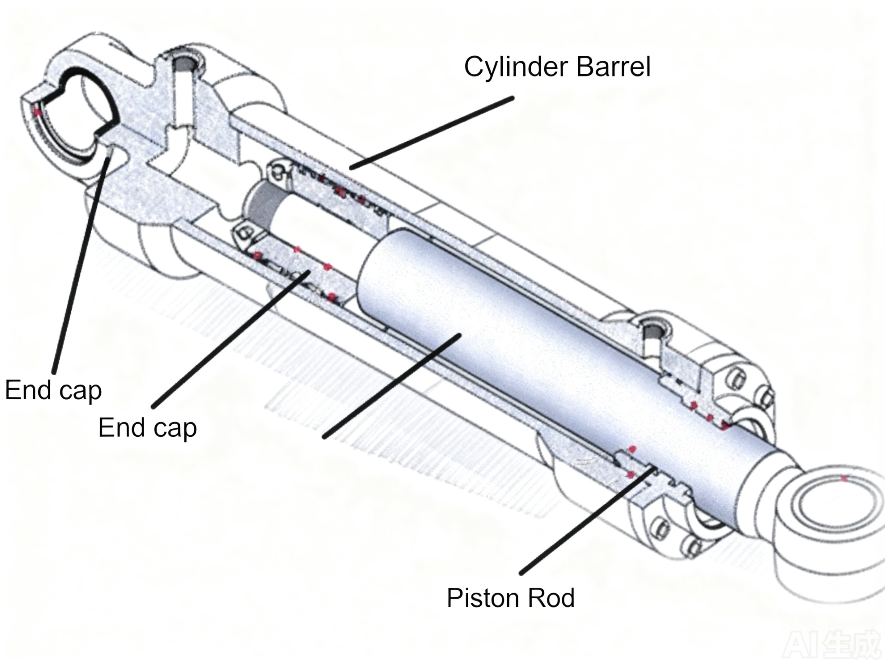
A basic hydraulic cylinder consists of three main parts: the cylinder barrel, piston, and piston rod. However, additional components like seals, end caps, and bearing elements are equally vital.
Cylinder Barrel
The main function of the cylinder barrel is to contain the pressurized fluid and withstand the internal forces. The barrel is typically made from a seamless steel tube, chosen for its strength and durability. Its inner surface is precision-ground and/or honed to a typical surface finish of 4 to 16 micro inches (0.1–0.4 µm Ra). This ultra-smooth finish reduces friction and wear as the piston reciprocates inside the barrel, while also ensuring an effective seal against the piston rings or seals.
Piston
The piston is a disc-shaped component that moves back and forth inside the barrel. Its primary function is to separate the pressure zones within the barrel—the high-pressure side from the low-pressure return side. The piston is machined with grooves to accommodate elastomeric or metal seals and bearing elements (wear rings). These seals can be single-acting (sealing in one direction) or double-acting (sealing in both directions). The difference in pressure between the two sides of the piston creates a net force, causing the cylinder to extend or retract. The piston is attached to the piston rod by means of threads, bolts, or nuts, allowing the linear motion of the piston to be transmitted to the rod.
Piston Rod
The piston rod is typically a hard chrome-plated piece of cold-rolled steel that attaches to the piston and extends outward from the cylinder through the rod-end head. In double rod-end cylinders, the actuator has a rod extending from both sides of the piston out both ends of the barrel—useful for applications requiring equal force and speed in both directions. The piston rod connects the hydraulic actuator to the machine component that performs the work, such as a bucket, blade, or press ram. This connection can be a machine thread, a clevis, a cross-tube, or other mounting attachments. The rod’s surface is highly ground and polished to provide a reliable seal with the rod wiper and pressure seal, preventing fluid leakage and keeping contaminants out.
Additional Components and Variations
Beyond these three core parts, hydraulic cylinders include end caps (heads), sealing systems, cushioning devices, and ports for fluid entry/exit. Common variations include telescopic cylinders (multiple nested stages for long stroke in a short retracted length), tie-rod cylinders (for easy maintenance), and welded cylinders (for heavy-duty use).
Conclusion
Hydraulic cylinders are the muscles of modern machinery—simple in concept yet remarkably powerful and versatile. By understanding their components and working principles, engineers and technicians can select, maintain, and troubleshoot these devices effectively. Whether moving a 100-ton excavator arm or pressing a car chassis, hydraulic cylinders deliver the force and control that industry demands.


